
In an earlier post, I looked at why David was chosen to be king, and at one detail in particular: God chose him knowing he would make mistakes. That detail is sometimes applied to modern leaders, especially Donald Trump and his administration, as a reason to keep supporting them even when they do things that seem wrong.
I think that kind of unwavering trust is more than we should give any human leader, as I argued in “Playing Chess with the Beast.” But even setting that aside, David’s story points to one behavior that matters a great deal: repentance. God chose both Saul and David, and presumably knew that both would sin. What set them apart was not whether they failed but what they did afterward. When confronted, David owned his sin, and Psalm 51 came out of it. Saul made excuses and justified himself (1 Samuel 15).
That suggests a test we could apply to the current administration: is Trump better described as a “David” or a “Saul”? Answering it directly is hard, though, because it means judging many actions that are politically disputed.
My most recent post, “Babylon Rising,” gives a clearer picture. In it I traced a structural change that took hold in America in the last decades of the twentieth century. Across eight domains, from corporations and health care to politics, finance and media, money, and with it power, became the measure of everything. I called this Babylon rising in America, because a system like that is one of the things Babylon represents in the book of Revelation.
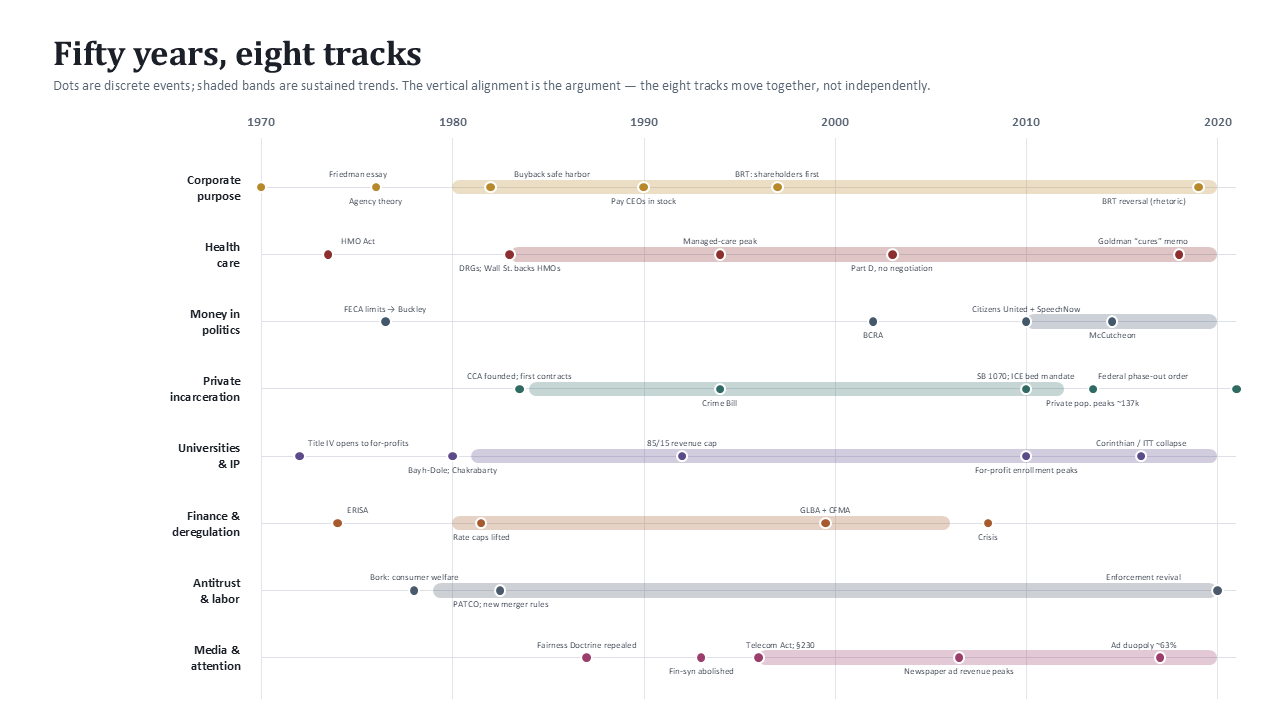
Figure 1: Click to expand.
If this shift has spread throughout our society, it should show up in the leaders we choose. My earlier analysis looked broadly across society and stopped around 2020. For this question, I revisited it and focused on the presidency. For every administration from Nixon to the present, I asked two questions about each of the eight domains. What did the administration’s policy do to it? And did the president or his immediate family personally take part in it, by holding a stake, receiving money, or otherwise having a financial link on the official record?
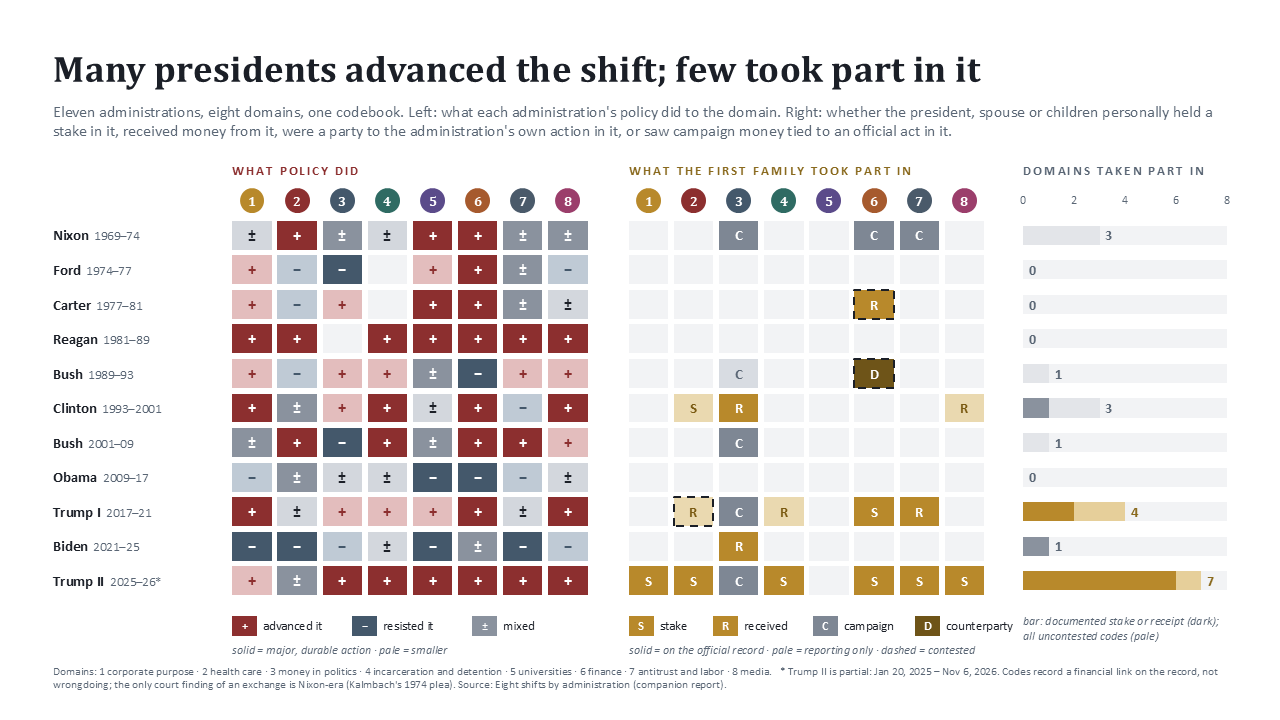
Figure 2: Click to expand.
On policy, only Reagan advanced the shift as broadly as Trump has. His administration pushed it forward in seven of the eight domains, and Trump’s second term comes in just behind. But Reagan kept his investments in a blind trust and had no personal stake in any of the eight domains. He backed the changes without taking part in them.
Personal involvement is where Trump stands alone. Before 2017, no president or immediate family took part in more than three of the eight domains. Counting only holdings or payments on the official record, none took part in more than one. Trump’s first term changed the kind of involvement: for the first time, a president kept an operating family business, and companies with matters before the government paid it. His second term changed the breadth: seven of the eight domains in about 22 months, six of them recorded on his own financial disclosures. Those disclosures show more than 21,000 securities trades in 2025, including trades in private-prison and health-insurer stocks, along with more than $1.4 billion in crypto income and the largest stake in the social-media company he uses as his main megaphone. These records show financial links, not findings of wrongdoing. The Trump Organization says outside managers make the trades, and no court has found a quid pro quo. But the question here is not legality. It is what kind of leader we chose. No earlier president has been so personally immersed in, and so enriched by, the system these changes created.
Trump, then, is a powerful example of the “Babylonian” outlook that has become widespread in American society. He also came to power through a democratic process, especially in his second term. So it is fair to say that voters chose the leader they believed could best fight their battles, the one who most embodied the qualities that fight seemed to require. That is exactly why Israel asked for Saul: “that we also may be like all the nations, and that our king may judge us and go out before us and fight our battles” (1 Samuel 8:20).
Considering both this picture and his conduct, I conclude that Trump is better understood as a type of Saul than as a type of David.
This matters not only for what it says about the current administration but for what it reveals about the people who elected him and support him. To the extent that choosing a Saul reflects a preference for “Babylonian,” or worldly, values, it also shows how far many of us are living in Babylon. And since some segments of the Christian church have been among Trump’s most dedicated supporters, parts of the church itself are in Babylon.
That is not a verdict on every voter, nor a claim that the other side stands outside Babylon. The same test applies to any leader and to any of us who would give a leader that kind of trust. The question is not which party we belong to, but whether our hope rests on someone who embodies Babylon’s values.
That brings us back to the urgent call of Revelation 18:4:
Then I heard another voice from heaven saying, “Come out of her, my people, lest you take part in her sins, lest you share in her plagues.” (ESV)
Coming out of Babylon has never meant fleeing society; it means withdrawing the trust and allegiance that belong only to God. As we keep asking how to be less lukewarm, how to become refreshing or healing, the question here is whether we must come out of Babylon to do it.


